WELCOME TO THE WORLD'S PREMIER CROP CIRCLES RESEARCH SITE.

For over a decade Crop Circle Secrets has led the way in helping the public make an informed decision on the true origin of crop circles. Its factual research provides an antidote to deliberate falsification of the genuine phenomenon by skeptics, hoaxers and their allies in the media.

Crop circles are scientifically proven to be manifestations of energy under intelligent guidance. Over 80 eyewitnesses describe them to be made by tubes of light in less than fifteen seconds. The evidence for crop circles as a genuine phenomenon is found in Freddy Silva's book Secrets In The Fields and throughout this site.

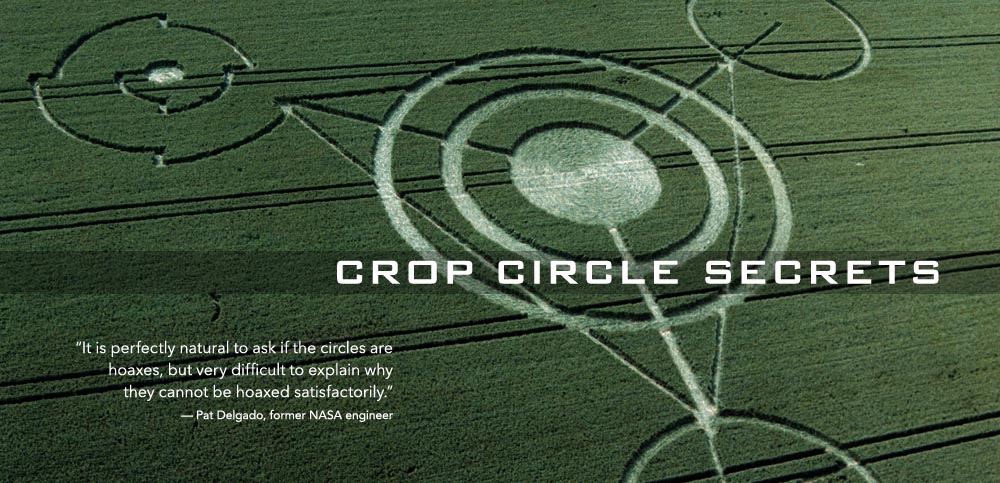
Contrary to popular perception, crop circles are not a modern phenomenon. They were witnessed by policemen and farmers as far back as 1890, they exist in the folklore of South Africa and China, and are mentioned in 17th Century academic texts. Around 1980 they re-appeared as simple circles and rings in southern England, where 75% of designs are reported. By the late 1980s they developed into pictograms, not unlike the petroglyphs found at sacred sites. After 1990 the designs developed exponentially in complexity, and today the crop circles display as fractals and elements expressing fourth dimensional processes in quantum physics.

To quell the public’s growing interest in crop circles, the British Secret Service MI5 presented two individuals named Doug and Dave to the media, via a fictitious press agency, as the makers of all crop circles. The majority of their claims were later proved to have been fabricated but never reported in the media. So, what exactly lies behind real crop circles?

In genuine formations the stems are not broken but bent and swirled; they are subjected to a short and intense burst of heat that softens the stems to hover just above the ground, where they re-harden without damage. Research suggests that infrasound is producing such an effect. It has also been scientifically proven that soil samples taken from within crop circles show changes in its crystalline structure and mineral composition. Expert analysis concludes that heat of 1500ºC would create such a change. These are hardly the kind of anomalies created by pranksters with planks!

Crop circles also show evidence of ultrasound, and such frequencies are known to exist at ancient sacred sites such as stone circles and pyramids. And like all temples, crop circles appear at the intersecting points of the Earth's magnetic pathways of energy. Consequently, it is not unusual for people to experience heightened states of awareness and healings in crop circles – a situation also common to sacred sites and ancient temples. Biophysical evidence shows the plants' seed embryos are altered, and the liquid in the stems has been heated from the inside. In genuine crop circles there is also a reorganization of the plant's crystalline structure. Other evidence from crop circles shows how the floors of laid plants are swirled in mathematical proportions relative to the Golden Ratio – the vortex used by nature to create organisms. Mathematically, genuine crop circles have yielded five new geometric theorems based on Euclidian geometry. They are also encoded with sacred geometry – those harmonic ratios that govern the relationship between the orbits of planets. Crop circles alter the local electromagnetic field; affecting the proper function of compasses, cameras and cellular phones; the frequencies are also known to affect aircraft equipment.

Look at the pictures, study the research or better still, read the comprehensive book. You'll get the message pretty quickly. And when you do, please link and share this extraordinary phenomenon with your friends. It is indeed the most important event shaping our lives. Which is precisely why it is being debunked.

January 16, 2012. Freddy Silva's new book, COMMON WEALTH now released under new title, Legacy of The Gods.
Plus, new DVD, "The Location of Paradise"

Add your email to Freddy Silva's personal mailing list. Please write your State and/or country.

MEDIA FRAUDS

IS SOUND CREATING CROP CIRCLES?

How hoaxers and the media brainwash you into believing that crop circles are made by people.

The main theory of how genuine crop circles are created.

INTRODUCING CROP CIRCLES

BIOPHYSICAL EVIDENCE

What exactly are they? Believe it or not, what you may have heard bears no resemblance to reality.

There exists over two decades of science behind crop circles. Here are a few examples proving the existence of a genuine phenomenon.

CASE HISTORIES

STORE

Scientific evidence for genuine crop circles is found in my book. Here are some case histories to whet your appetite.

The most comprehensive crop circles book, several DVDs, posters and other nice things.

SUBCONSCIOUS INTERACTION

THE TECHNOLOGY OF CROP CIRCLES

The fascinating thing about crop circles is they work at a subtle level. It's here where communication takes place with the invisible.

A number of scientists and inquisitive people have discovered crop circles encode advanced technology.

EUCLIDEAN THEOREMS

SUBTLE ENERGIES

SACRED GEOMETRY OF CROP CIRCLES

Advanced maths have been proved to be encoded in crop circles. And for the first time in 2300 years, five new theorems have been discovered.

Crop circles and their subtle forces. are often found through dowsing or the use of magnetometers. Either way, these subtle energies interact with biological systems in interesting ways.

Sacred geometry is embedded in crop circles, much in the same way as it is used in ancient sacred sites.

ALTERED STATES

THE HISTORY OF CROP CIRCLES

Yes, crop circles influence biological systems.

A year-by-year synopsis of the phenomenon.

NEWS OF THE MEGALITHIC AND THE SCIENTIFIC

Lima uncovers 1,600-year old stone complex
Marcahuamachuco, an enigmatic 1,600-year-old archeological complex built from stone in the northern Peruvian Andes, is emerging bit by bit from oblivion and could become a beacon of tourism on the scale of Machu Picchu. Spread over 590 acres (240 hectares) on a plateau more than 12,000 feet (3,700 meters) high in the mountains, the pre-Incan site embodies all the evils that have befallen Peru's archeological treasures.
Though still full of mysteries — who lived here, and why, is unknown — the complex has been plundered of artifacts that might help unlock its secrets, and has long been subjected to the depredations of nature.
But it's still there, groups of sometimes monumental stone building, massive rounded walls that rise 10 to 15 meters (yards), galleries, a rectangular plaza and dwellings, and an urban religious center with a sanctuary.
“All of it walled in, a fortress of stone on a plateau to defend against invasion,” said Cristian Vizconde, the government's chief archeologist.
Marcahuamachuco — in Quechua, “the people of the men with hawk-like headdresses” — has been studied by archeologists since 1900.
Parts of the site are still buried under centuries of accumulated earth, masking its true dimensions.
But its splendor was revealed anew in October 2010 when brush was cleared away as part of a major preservation effort by the government in partnership with the Global Heritage Fund, a nonprofit whose mission is to protect endangered world cultural heritage sites.
The fund is providing scientific help to study, preserve and make Marcahuamachuco — long overshadowed by the far more celebrated Machu Picchu more than 1,000 kilometers (600 miles) away — ready for sustainable tourism. The goal is to get it registered as a world heritage site by UNESCO.
“It is the most important pre-Inca center in the Andes, with its own language, culli (which lasted until the 20th century), with its own gods and buildings unlike any seen in Peruvian archeological sites,” he said.
Even so, the complex remains shrouded in mystery.
“We don't know what culture Marcahuamachuco belonged to. We do know that the stone structures, with walls 10 to 15 meters (yards) high, were built between 350 and 400 A.D. but we don't know when its inhabitants arrived or where they came from,” said Vizconde.
Canadians John Topic and Theresa Lange-Topic, who have studied the complex, believe its last inhabitants left around the 13th century and that when the Incas arrived two centuries later they found only shepherds among the ruins.
“It's not known why they went, possibly because of an epidemic, but it's all a mystery that remains to be solved,” said Vizconde.
Archeologists hope to find clues in burial sites found behind thick walls in an area of the complex called the Castle where priests or nobles may have been buried.
“Those places have been sacked but the few human remains that were left will be analyzed with the help of GHF,” Vizconde said, adding that another possible cemetery was found recently and could give up more secrets.
Julio Vargas, a GHF expert on archeological structures, said he was impressed by the size of the buildings and the mortar work used to join stones in a way that has endured centuries of rain, wind and abandonment.
“What strikes me is the incredible transparence of the ensemble: it was very open, as if it were a public message, built to impress, to show the power of a dynasty, I would imagine,” said John Hurd, a GHF advisor.
Hurd said the site is so imposing that it could “break the dependence of the tourism industry on Machu Picchu.”
Tourism could bring work and respect for the ancient ruins in an area where more than 300 other archeological sites are endangered by informal gold mining.
Luis Alberto Rebaza, the mayor of Huamachuco province, which has 150,000 people, calls the site's tourism potential “the great opportunity of my people.”


Company digging mine in Afghanistan unearths 2,600-year-old Buddhist monastery
(Daily Mail) A Chinese company digging an unexploited copper mine in Afghanistan has unearthed ancient statues of Buddha in a sprawling 2,600-year-old Buddhist monastery.
Archaeologists are rushing to salvage what they can from a major 7th century B.C. religious site along the famed Silk Road connecting Asia and the Middle East.
The ruins, including the monastery and domed shrines known as 'stupas,' will likely be largely destroyed once work at the mine begins.
The ruins were discovered as labourers excavated the site on behalf of the Chinese government-backed China Metallurgical Group Corp, which wants to develop the world's second largest copper mine, lying beneath the ruins.
Hanging over the situation is the memory of the Buddhas of Bamiyan — statues towering up to 180 feet high in central Afghanistan that were dynamited to the ground in 2001 by the country's then-rulers, the Taliban, who considered them symbols of paganism.
No one wants to be blamed for similarly razing history at Mes Aynak, in the eastern province of Logar. MCC wanted to start building the mine by the end of 2011 but under an informal understanding with the Kabul government, it has given archaeologists three years for a salvage excavation.
Archaeologists working on the site since May say that won't be enough time for full preservation. The monastery complex has been dug out, revealing hallways and rooms decorated with frescoes and filled with clay and stone statues of standing and reclining Buddhas, some as high as 10 feet. An area that was once a courtyard is dotted with stupas standing four or 5ft high.More than 150 statues have been found so far, though many remain in place. Large ones are too heavy to be moved, and the team lacks the chemicals needed to keep small ones from disintegrating when extracted.'That site is so massive that it's easily a 10-year campaign of archaeology,' said Laura Tedesco, an archaeologist brought in by the US Embassy to work on sites in Afghanistan. 'Three years may be enough time just to document what's there.'
Philippe Marquis, a French archaeologist advising the Afghans, said the salvage effort is piecemeal and 'minimal', held back by lack of funds and personnel.The team hopes to lift some of the larger statues and shrines out before winter sets in this month, but they still haven't procured the crane and other equipment needed.Around 15 Afghan archaeologists, three French advisers and a few dozen labourers are working within the 0.77-square-mile area - a far smaller team than the two dozen archaeologists and 100 labourers normally needed for a site of such size and richness.
'This is probably one of the most important points along the Silk Road,' said Marquis. 'What we have at this site, already in excavation, should be enough to fill the (Afghan) national museum.'
Mes Aynak, 20 miles south of Kabul, lies in a province that is still considered a major transit route for insurgents coming from Pakistan. In July, two US sailors were kidnapped and killed in Logar. Around 1,500 Afghan police guard the mine site and the road.
Mes Aynak's religious sites and copper deposits have been bound together for centuries — 'mes' means 'copper' in the local Dari language. Throughout the site's history, artisanal miners have dug up copper to adorn statues and shrines.
Afghan archaeologists have known since the 1960s about the importance of Mes Aynak, but almost nothing had been excavated. When the Chinese won the contract to exploit the mine in 2008, there was no discussion with Kabul about the ruins - only about money, security and building a railroad to transport the copper out of Logar's dusty hills.
But a small band of Afghan and French archaeologists raised a stir and put the antiquities on the agenda.The mine could be a major boost for the Afghan economy. According to the Afghan Mining Ministry, it holds some 6 million tons of copper, worth tens of billions of dollars at today's prices. Developing the mine and related transport infrastructure will generate much needed jobs and economic activity.
Waheedullah Qaderi, a Mining Ministry official working on the antiquities issue, said MCC shares the government goal of protecting heritage while starting mining as soon as possible.


Solving the Mystery of a 35,000-Year-Old Statue
(Die Spiegel) Archeologists have discovered previously unknown fragments of a figurine known as the "Lion Man," and are piecing it back together. Could the 35,000-year-old statue actually represent a female shaman? Scientists hope to resolve a decades-long debate. Using a hand hoe and working in dim light, geologist Otto Völzing burrowed into the earth deep inside the Stadel cave in the Schwäbische Alb mountains of southwestern Germany. His finds were interesting to be sure, but nothing world-shaking: flints and the remnants of food eaten by prehistoric human beings.
Suddenly he struck a hard object -- and splintered a small statuette.
It was 1939 and Völzing didn't have much time. He had just been called up to serve in the military and World War II was about to begin. He quickly packed the pieces into a box and the excavation, which was being financed by the SS, was terminated on the same day.
For the next 30 years, little heed was paid to the pieces. But then, they were reassembled to create one of the most impressive sculptures of the Paleolithic Age.
Called the Lion Man, it is fashioned from the tusk of a mammoth and stands about 30 centimeters (12 inches) tall. Its creator polished it with saliva and leather -- and an experiment showed that it likely took the sculptor about 320 hours to carve the figure.
Copies of the famous ice age treasure are now on display in New York and Tokyo. The original, however, is heavily damaged -- and no one knows exactly what it looks like. Many fragments were overlooked in the cave when the prewar dig was so abruptly terminated. The figure achieved its current form in 1988. It consists of 220 parts, but about 30 percent of the body is still missing. Large segments of the surface have broken off.
The poor condition of the figurine has only made it more mysterious. Is it meant to represent a mythical creature, or a shaman hiding under an animal hide? Are the six stripes on the left upper arm meant to depict scarification marks or something else? And what was on the right arm, which is missing?
The genitalia are also unrecognizable. German archeologist and Upper Paleolithic expert Joachim Hahn has interpreted the small plate on the abdomen as a "penis in a hanging position." Elisabeth Schmid, a paleontologist, classified it as a pubic triangle.
It was the beginning of a bitter dispute over the gender of the small idol that erupted in the 1980s and continues to this day. The statue has been made into an "icon of the women's movement," says Kurt Wehrberger of the Ulm Museum, the owner of the precious object.
Those who believe that the Lion Man is in fact a woman are convinced that primitive societies were matriarchal. They contend that women of the period, instead of standing obediently by the cooking fire and watching over the children, hunted mammoths and set the tone when it came to rituals and the priesthood. But is this true?
The debate remains undecided today. But that could soon change, now that new fragments of the Lion Man have turned up.
The new discoveries came after archeologists once again turned their attention to the Stadel cave. They sifted through all of the rubble from 1939, explains excavator Claus-Joachim Kind -- and the results were sensational. "We found about 1,000 pieces, which presumably belong to the statue," Kind says.
Some of the fragments are tiny, only a few square millimeters in size, but the cache also includes pieces as long as a finger.
The figurine will be taken to the State Conservation Office in Esslingen, near Stuttgart, where it will be completely taken apart. The old glue joints will be dissolved and the filler made of beeswax and chalk, which was used as a placeholder, will be removed.
Then the statue will be reassembled piece by piece, a task that those involved await with great anticipation. "We will soon be able to view the most mysterious work of art from (the southwestern German state of) Baden-Württemberg in its original form," Kind hopes.
Already it is clear that the figurine will become a few centimeters taller due to new neck pieces that have been found. Furthermore, the gaping hole in the back can now be plugged, and the right arm has been found in its entirety. Additional decorations, including raised dots and strange-looking lines, have come to light.
These new revelations offer a greater insight into the mind of the prehistoric sculptor, who created the figure about 35,000 years ago. His ancestors had migrated to Europe, which had been controlled by the Neanderthals, shortly before.
The statue was found near traces of a fire site in a niche 27 meters (89 feet) from the mouth of the cave. When Kind was working at the site, he also found a decorated deer's tooth, the incisors of an arctic fox and ivory beads. The items could have been pieces from a decorative robe. Perhaps the niche served as a shaman's changing room.
It is considered likely that prehistoric sorcerers wore furs as costumes when they celebrated rituals around the campfire. Hybrid creatures -- half-man, half-beast -- also appear in cave drawings in France.
It would seem that the shamans' preferred costumes were the hides of the more dangerous representatives of Ice Age fauna. The cave lion weighed more than 250 kilograms (550 lbs.); one swipe of its giant paw would have been enough. A human being holding what looks like a musical instrument is depicted in a cave in the foothills of the Pyrenees. The figure is wearing the hide of a bison, an 800-kilogram colossus that was not to be trifled with. Perhaps hunters hoped to acquire the animal's strength and even take possession of its soul through masquerade and dance.
Studies about primitive peoples in Siberia suggest how these rites might have proceeded. Even into the modern age, their shamans wore antlers on their heads. There are similar accounts involving the Blackfeet Indians in North America. Their healers hopped around under bearskins to the sound of drums.
The Lion Man is standing on tiptoes. He, too, seems to be dancing.
But who is hidden underneath the robe? From time immemorial, the lion has been viewed as a symbol of the masculine virtues of courage and strength. Shamans still exist today in the Amazon region and Australia. Most are men.
On the other hand, the statuette has some perplexing features. The navel, a symbol of childbirth, is especially pronounced. A horizontal crease runs across the lower abdomen, a feature that is typically female.
Paleontologist Schmid believes that the figure once had breasts, which eventually broke off. According to Schmid, the transition from the thighs to the buttocks is also indicative of a female body. She made a model out of modeling clay, which is now in a safe in Ulm. It depicts the Lion Man with an ample bosom.
Many scholars dismissed the jarring replica as nonsense at the time. Nevertheless, there is at least one piece of evidence to support Schmid's theory. An image of a 14,000-year-old human body with an animal head discovered in the Las Caldas cave in Spain is obviously female. The head looks like that of an ibex, while the lower part of the body features female genitalia.
Does this mean that female shamans did exist? Were women in charge of the religion of our ancestors? The new finds could solve the mystery once and for all. Hundreds of tiny ivory fragments will have to be pieced together to create a statue that experts estimate will contain 20 percent more of its original material.
According to one of the excavators, there is also sufficient fragmentary material to reconstruct the genitalia. "We'll figure out the gender," he says.


The earth mother of all neolithic discoveries
(The Independent) French archaeologists have discovered an extremely rare example of a neolithic "earth mother" figurine on the banks of the river Somme.
The 6,000-year-old statuette is 8in high, with imposing buttocks and hips but stubby arms and a cone-like head. Similar figures have been found before in Europe but rarely so far north and seldom in such a complete and well-preserved condition.
The "lady of Villers-Carbonnel", as she has been named, can make two claims to be an "earth mother". She was fired from local earth or clay and closely resembles figurines with similar, stylised female bodies found around the Mediterranean.
Although neolithic experts are revising their opinions, the figures have long believed to have been connected with the existence of a cult which worshipped a goddess of the hearth or of fertility.
The Somme "earth mother" appears to have broken into five or six parts while she was being fired between 4300 and 3600 BC. She was found in the ruins of a neolithic kiln at a French government "preventive" archaeological dig near Villers-Carbonnel on the banks of the river Somme in the département of the same name. The figurine may be just the beginning of a vast archaeological harvest in Northern France in the next few years, stretching from palaeolithic times to the First World War. The French government's "preventive archaeology" agency, Inrap, has been given permission and the funds to explore 77 sites along the 60-mile course of the new 50m-wide Seine-Nord Europe canal for ocean-going barges linking the river Seine to Belgium and the Rhine. The archaeologist in charge of the Villers-Carbonnel dig, Françoise Bostyn, told The Independent: "The statuette is very beautiful and remarkably preserved. We sometimes find fragments of such statuettes but rarely the whole figure."
The "earth mother of the Somme" may owe her survival, paradoxically, to the fact that she was broken while being made. Her various pieces were discovered in a collapsed kiln or oven.
Ms Bostyn said that the stylised figure, with inflated buttocks and thighs and rudimentary head and arms, closely resembled similar figures from the period found as far away as the Middle East. Could the "lady of Villers-Carbonnel" represent the neolithic ideal of female beauty, long before the coming of fashion magazines, airbrushes and Photoshop?